
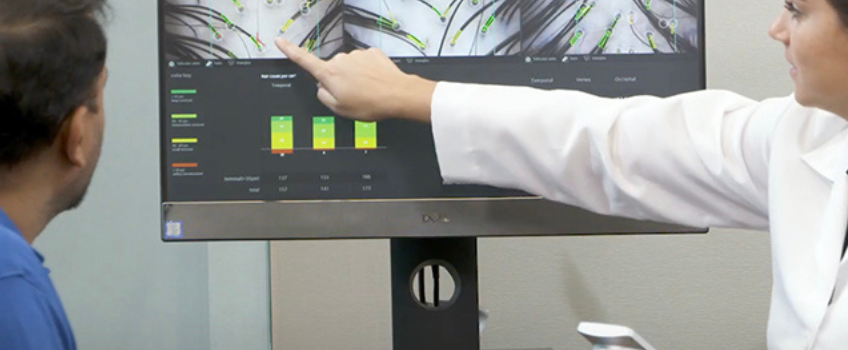
Hair loss can be difficult to evaluate accurately using ordinary photographs or visual inspection alone. Subtle changes in hair density, hair-shaft thickness and follicular activity may be hard to see—especially during the early stages of thinning.
HairMetrix® addresses this limitation by combining high-resolution digital trichoscopy with AI-assisted analysis. The system captures detailed images of the hair and scalp and produces objective measurements that can be compared over time.
At LMC – Laser Medical Clinic in Richmond Hill, HairMetrix may be used as part of a comprehensive hair-loss assessment and to monitor patients receiving personalized hair-restoration treatments.
What Is HairMetrix AI Hair Analysis?
HairMetrix is a non-invasive digital hair and scalp analysis system. Unlike assessments that require hairs to be clipped, plucked or sent to a laboratory, HairMetrix analyzes selected areas of the scalp without removing hair.
Specialized imaging captures close-up views of the scalp and visible hair follicles. AI-assisted software then helps calculate measurable characteristics such as hair density, hair-shaft thickness and the number of hairs growing from each follicular unit.
Learn more about the complete
HairMetrix AI hair and scalp analysis offered at LMC.
What Can HairMetrix Measure?
HairMetrix can provide several measurements that help establish a baseline and document changes during a hair-restoration plan.
- Hair count: The approximate number of visible hairs within the analyzed area.
- Hair density: The number of hairs measured per square centimetre.
- Hair-shaft thickness: The average diameter or calibre of the analyzed hairs.
- Follicular units: The number of visible follicular units and the average number of hairs growing from each unit.
- Terminal-to-vellus ratio: The relationship between thicker terminal hairs and finer, miniaturized hairs.
- Scalp condition: High-resolution images may reveal visible redness, scaling, oil accumulation or other scalp concerns requiring further assessment.
These measurements do not replace a medical diagnosis. However, they give the provider more objective information to interpret alongside the patient’s medical history, hair-loss pattern, symptoms and treatment history.
How Is HairMetrix Different From a Visual Hair Assessment?
A traditional hair-loss consultation remains important. The provider needs to examine the scalp, review the pattern and duration of hair loss, discuss medical history and identify possible contributing factors.
The limitation is that visual inspection and standard photographs can be subjective. Lighting, camera angle, hair length, styling and moisture can make the scalp appear better or worse between appointments.
HairMetrix adds numerical measurements to the assessment. When the same areas are evaluated under reasonably consistent conditions, the provider can compare data instead of relying entirely on memory or photographs.
Four Benefits of HairMetrix AI Trichoscopy
1. High-Resolution Hair and Scalp Imaging
HairMetrix captures magnified images that allow the provider to examine the visible hair shafts, follicular units and scalp more closely. These images can help document areas affected by thinning, miniaturization or reduced density.
2. Objective Baseline Measurements
Before beginning treatment, HairMetrix can establish baseline measurements for selected areas of the scalp. This creates a more reliable starting point for future comparisons.
3. Progress Tracking Over Time
Hair restoration develops gradually, and visible changes may take months. Follow-up HairMetrix assessments can help determine whether measured density, shaft thickness or follicular characteristics have changed during treatment.
Tracking does not guarantee that every patient will improve. It provides better evidence for deciding whether a treatment plan should be continued, adjusted or reconsidered.
4. Immediate, Easy-to-Understand Reports
Results can be reviewed during the appointment without sending hair samples to an outside laboratory. Visual reports also make it easier for patients to understand their current hair density and compare future measurements.
Can HairMetrix Diagnose the Cause of Hair Loss?
HairMetrix can identify and measure visible patterns associated with hair thinning, but it cannot independently diagnose every cause of hair loss.
Hair shedding and reduced density can be associated with androgenetic alopecia, hormonal changes, nutritional deficiencies, thyroid conditions, illness, medications, stress, inflammatory scalp disorders and other medical factors. Bloodwork, a physician or dermatologist assessment, or additional testing may sometimes be necessary.
For patients whose treatment options may be influenced by inherited characteristics, LMC also offers
TrichoTest genetic hair-loss testing.
HairMetrix and TrichoTest serve different purposes: HairMetrix measures visible hair and scalp characteristics, while TrichoTest evaluates selected genetic variations related to hair-loss treatment response.
How HairMetrix Supports Personalized Hair-Restoration Treatment
Not every person experiencing hair loss needs the same treatment. The appropriate approach depends on the cause and stage of hair loss, the condition of the scalp, whether active follicles remain and the patient’s medical history.
HairMetrix findings may be considered when creating or reviewing a treatment plan involving:
- PRP hair restoration
for selected patients with active follicles and early-to-moderate thinning. - PRF hair restoration
when a platelet-rich fibrin preparation is considered appropriate. - scalp mesotherapy
as a supportive, non-surgical scalp treatment. - MCT hair-restoration treatments
when recommended as part of a personalized regenerative plan. - Medical treatment, nutritional support or referral to another healthcare professional when indicated.
HairMetrix does not determine the treatment by itself. Its measurements are one part of a broader assessment performed by the provider.
Using HairMetrix to Monitor PRP and PRF Hair Treatments
PRP and PRF treatments are prepared from the patient’s own blood and delivered into targeted areas of the scalp. These treatments are intended to support existing, active follicles; they cannot create new follicles in completely bald areas.
During a treatment plan, follow-up HairMetrix imaging may help evaluate whether measurable changes are occurring. Depending on the patient, the provider may review changes in hair count, density, shaft calibre or terminal-to-vellus ratio.
This information can support more informed decisions about treatment frequency, maintenance and whether the current approach remains appropriate. Results vary, and changes should always be interpreted within the context of the full clinical assessment.
Who May Benefit From a HairMetrix Assessment?
HairMetrix may be useful for men and women experiencing:
- A widening part line
- Reduced hair density
- A receding hairline
- Thinning around the crown or temples
- Increased or persistent shedding
- Changes in hair-shaft thickness
- Possible hair miniaturization
- Uncertainty about whether a current treatment is working
It may also be valuable before beginning treatment because it creates baseline measurements that can be used for future comparison.
How to Prepare for a HairMetrix Appointment
For clearer and more consistent images, arrive with a clean scalp and avoid products that may conceal the hair or interfere with imaging.
- Avoid hair fibres, scalp powders and root-concealing sprays.
- Avoid applying heavy oils, gels, waxes or dry shampoo to the scalp.
- Wear your hair so the areas of concern can be accessed easily.
- Tell your provider about medications, supplements and current hair-loss treatments.
- Bring any relevant bloodwork or previous hair-loss assessments when available.
Start With a Professional Hair-Loss Assessment
Hair-loss treatments generally have the greatest potential when thinning is assessed early and active follicles are still present. Waiting until an area is completely bald can significantly limit non-surgical treatment options.
LMC – Laser Medical Clinic provides personalized hair-loss consultations for patients in Richmond Hill, Toronto, Vaughan, Markham, Aurora and surrounding GTA communities. Your provider will review your scalp, hair-loss pattern, medical history and goals before recommending an appropriate next step.
Book a complimentary hair-restoration consultation
or review LMC’s
hair-restoration treatment pricing
before your visit.
Individual results vary. HairMetrix supports hair and scalp assessment but does not replace medical diagnosis, laboratory testing or evaluation by a qualified healthcare professional when required.
To book your complimentary consultation appointment, call us at 416-548-6548
Book a Consultation