
Does PRP Work for Alopecia Areata? Benefits, Evidence & What to Expect
PRP may help some people with alopecia areata regrow hair.
Platelet-rich plasma (PRP) uses concentrated platelets from your own blood
and is injected into areas affected by hair loss. Clinical studies suggest
PRP can improve alopecia areata, although results vary and it is not the
right treatment for every patient.
What Is Alopecia Areata?
Alopecia areata is an autoimmune form of hair loss. It develops when the
immune system attacks hair follicles, often causing sudden, round or oval
patches of hair loss on the scalp, beard or other parts of the body.
Some people experience only one or two patches. Others develop more
extensive hair loss. Because several conditions can cause patchy or sudden
hair loss, an accurate diagnosis should come before choosing a treatment.
Can PRP Help Alopecia Areata?
Research suggests PRP can be a useful treatment option for some
patients with alopecia areata. Studies have reported improvements
in hair regrowth and alopecia severity following PRP treatment.
However, PRP should not be presented as a guaranteed cure. Alopecia areata
can behave differently from one person to another, and treatment decisions
depend on the extent of hair loss, medical history, previous treatments and
other clinical factors.
How Does PRP for Alopecia Areata Work?
PRP stands for platelet-rich plasma. During treatment, a small amount of
your blood is collected and processed in a centrifuge. This separates and
concentrates platelets within the plasma.
The resulting PRP is then injected into selected areas of the scalp.
Platelets contain growth factors and other signaling proteins involved in
tissue repair and cellular activity.
Researchers have proposed several ways PRP may support hair follicles,
including:
-
Supporting follicle activity:
Growth factors may stimulate cells involved in the hair-growth cycle. -
Supporting blood-vessel formation:
PRP may promote vascular activity around treated tissue. -
Influencing inflammation:
PRP contains signaling molecules that may affect inflammatory processes. -
Supporting tissue repair:
Platelets play an important role in normal healing and regeneration.
These mechanisms are still being studied, particularly in autoimmune hair
loss. PRP does not simply “switch off” alopecia areata, and responses vary.
What Does the Research Say About PRP for Alopecia Areata?
The research is encouraging, but it should be interpreted carefully.
A 2022 systematic review by Tejapira and colleagues examined published
research involving PRP for alopecia areata and other immune-mediated
alopecias. The review found evidence supporting PRP as a potential treatment
for alopecia areata while also highlighting differences among studies and
PRP preparation methods.
Another 2022 systematic review and meta-analysis by Meznerics and colleagues
evaluated randomized clinical trials of PRP for alopecia areata.
Both PRP and intralesional triamcinolone groups showed improvement in
alopecia severity. Across the pooled trials, researchers did not find a
statistically significant difference in mean SALT-score improvement between
PRP and triamcinolone.
In plain English? PRP appears promising, but current evidence does
not prove that it is universally better than corticosteroid injections.
It can, however, be worth discussing when a patient wants to explore a
non-steroid treatment approach.
PRP vs. Steroid Injections for Alopecia Areata
Corticosteroid injections are commonly used for localized alopecia areata.
PRP takes a different approach and uses material prepared from the patient’s
own blood.
| Feature | PRP | Corticosteroid Injections |
|---|---|---|
| Material used | Platelet-rich plasma from the patient’s blood | Corticosteroid medication |
| Contains steroids? | No | Yes |
| Procedure | Scalp injections | Scalp injections |
| Evidence for alopecia areata | Promising but still developing | Established treatment used by dermatologists |
| Possible local effects | Pain, tenderness, redness or swelling | Pain plus possible skin thinning or pigment changes |
The better choice depends on the patient. It isn’t simply a contest between
PRP and steroids. Diagnosis, severity, previous treatment response and
medical history all matter.
What Happens During PRP Hair Treatment?
-
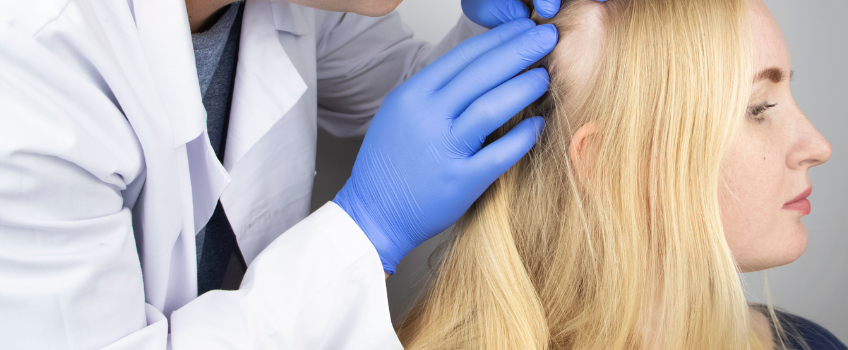
Hair-loss assessment.
Your scalp and pattern of hair loss are evaluated. At our clinic, this
assessment may include HairMetrix imaging to measure hair and scalp
characteristics. -
Blood collection.
A small amount of blood is drawn. -
PRP preparation.
The blood is processed in a centrifuge to concentrate the platelet-rich
portion. -
Scalp treatment.
The prepared PRP is injected into selected areas affected by hair loss.
Our clinic can use the U225 device for controlled delivery. -
Aftercare.
Most patients can return to many normal activities shortly after
treatment. Individual aftercare instructions are provided. -
Follow-up.
Progress is assessed over time and further sessions are recommended when
clinically appropriate.
How Many PRP Sessions Are Needed for Alopecia Areata?
There is no single PRP schedule that works for every alopecia areata
patient. The number and timing of treatments can vary according to the
protocol being used, the extent of hair loss and the patient’s response.
Your treatment schedule should therefore be based on an individual
assessment rather than a guaranteed number of sessions.
Is PRP for Alopecia Areata Safe?
PRP is prepared from the patient’s own blood, which avoids exposure to a
donor blood product. Temporary effects can include tenderness, redness,
swelling, itching or discomfort around injection sites.
PRP isn’t appropriate for everyone. Certain platelet disorders, bleeding
or clotting conditions, medications, infections and other medical issues
may affect whether treatment is suitable.
A proper medical assessment is therefore important before treatment.
Who May Consider PRP for Alopecia Areata?
PRP may be worth discussing if you have been diagnosed with alopecia
areata and want to explore a non-steroid treatment option. It may also be
considered when previous approaches have not produced the desired response
or when a clinician believes PRP could complement a broader treatment plan.
PRP is not automatically the right answer for every type of hair loss.
That’s why diagnosis comes first.
Frequently Asked Questions About PRP and Alopecia Areata
Does PRP work for alopecia areata?
PRP may improve hair regrowth in some people with alopecia areata.
Randomized trials and systematic reviews have reported encouraging results,
but responses vary and additional research is needed.
Is PRP better than steroid injections for alopecia areata?
Current evidence does not establish PRP as universally better than
corticosteroid injections. A 2022 meta-analysis found improvement with both
PRP and intralesional triamcinolone without a significant difference in
pooled SALT-score improvement.
Is PRP a steroid-free treatment?
Yes. PRP is prepared from the patient’s own blood and does not contain
corticosteroids.
Can PRP cure alopecia areata permanently?
PRP should not be described as a permanent cure for alopecia areata.
Alopecia areata is an autoimmune condition and its course can vary.
Hair regrowth and recurrence differ between patients.
How soon will I see hair growth after PRP?
Hair growth is gradual, and the response varies between patients.
Progress should be assessed over several months using photographs,
clinical examination or hair-measurement technology when appropriate.
Does PRP hurt?
PRP involves multiple injections, so temporary discomfort or tenderness
can occur. The experience varies according to the treatment area,
injection technique and individual sensitivity.
Could PRP Be Right for Your Alopecia Areata?
Patchy hair loss deserves a proper diagnosis. If you’ve been diagnosed
with alopecia areata and want to know whether PRP belongs in your treatment
plan, start with a personalized hair and scalp assessment.
References
Meznerics FA, Illés K, Dembrovszky F, et al.
Platelet-Rich Plasma in Alopecia Areata—A Steroid-Free Treatment
Modality: A Systematic Review and Meta-Analysis of Randomized Clinical
Trials. Biomedicines. 2022;10(8):1829.
Tejapira K, Yongpisarn T, Sakpuwadol N, Suchonwanit P.
Platelet-rich plasma in alopecia areata and primary cicatricial
alopecias: A systematic review.
Frontiers in Medicine. 2022;9:1058431.
To book your complimentary consultation appointment, call us at 416-548-6548
Book a Consultation