
What Is Hair Mesotherapy? Benefits, Results and Hair Growth Treatment in Toronto
Hair mesotherapy is a targeted scalp treatment that delivers vitamins, amino acids, peptides, minerals and hyaluronic acid directly into areas affected by thinning, shedding and weakened hair.
No pills floating around your entire body. No serum sitting on top of your scalp hoping for the best.
The ingredients go where the problem is.
At LMC, hair mesotherapy is performed with PLURYAL® MESOLINE Hair, a professional scalp formulation designed to nourish hair follicles, support healthier hair growth, reduce the appearance of thinning and improve scalp health.
And LMC does not guess.
Hair loss can be genetic, hormonal, nutritional, medical or a messy mix of several factors. That is why treatment may start with an advanced HairMetrix® AI scalp analysis before a treatment plan is built.
What Is Hair Mesotherapy?
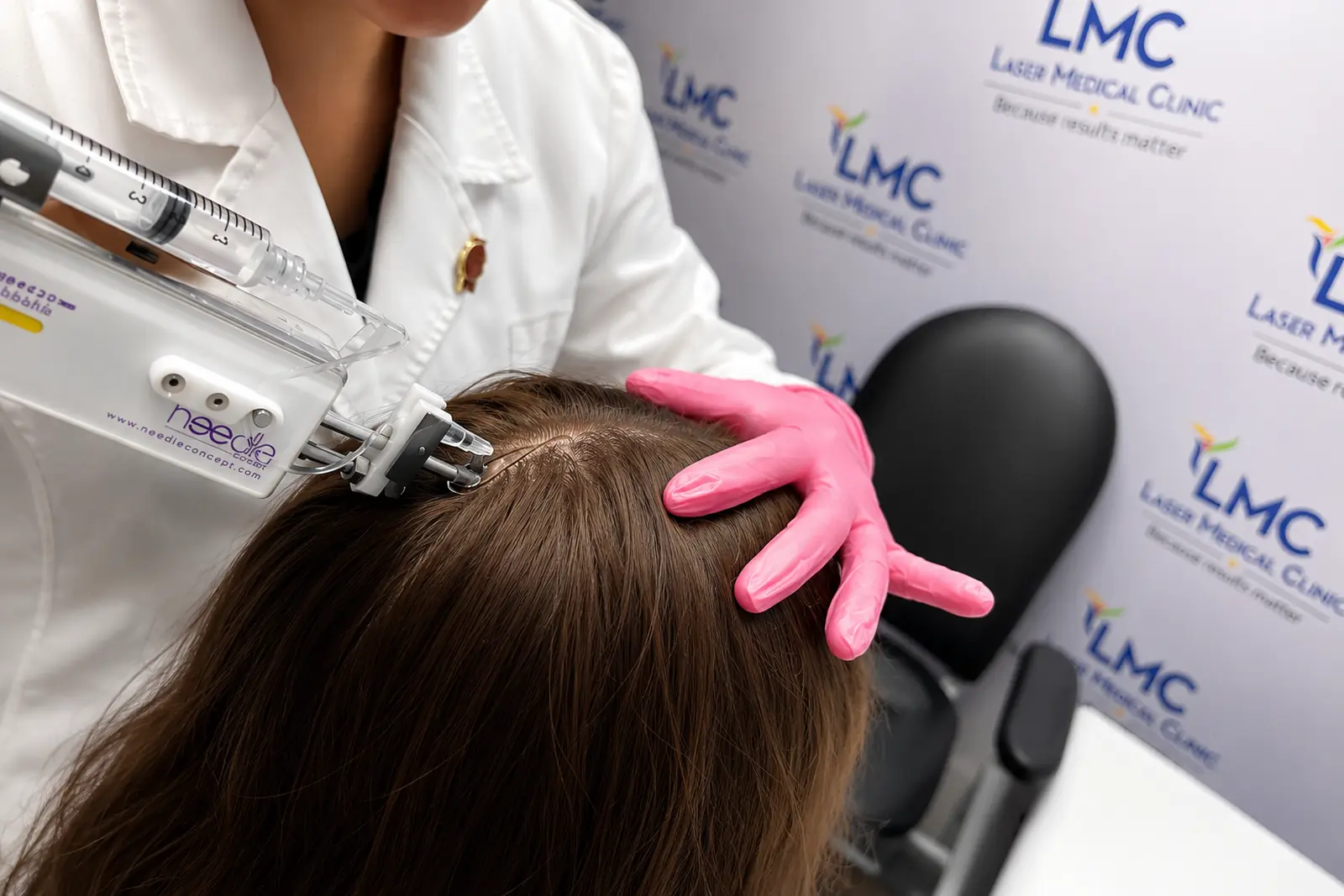
Hair mesotherapy uses a series of precise microinjections to deliver active ingredients directly into targeted areas of the scalp.
The goal is simple: create a healthier environment around struggling hair follicles.
The formula can include ingredients selected to support follicular activity, scalp hydration, hair strength and overall hair quality.
At LMC, PLURYAL MESOLINE Hair contains a combination of:
- Peptides to support scalp and follicular health
- Amino acids that contribute to hair structure
- B vitamins for nutritional scalp support
- Hyaluronic acid to hydrate and condition the scalp
- Caffeine to support scalp vitality
- Coenzyme Q10 for antioxidant support
It is a direct, concentrated approach.
For people tired of weak hair, excessive shedding or reduced density, that is exactly the point.
Does Hair Mesotherapy Work for Hair Loss?
Hair mesotherapy may help reduce hair thinning, improve scalp health and support stronger, healthier-looking hair in appropriately selected patients.
It is especially popular for early or moderate thinning, excessive shedding and reduced hair quality.
But here is what matters.
Hair mesotherapy is not a magic fix for every form of hair loss.
If a follicle is severely miniaturized, scarred or no longer viable, injecting nutrients into the scalp cannot magically rebuild it.
That is why LMC assesses the scalp first.
The goal is to find active follicles worth supporting and build a plan around what your hair is actually doing.
How Does Hair Mesotherapy Work?
Hair mesotherapy bypasses the usual detour of swallowing a supplement or applying a topical product and hoping enough active ingredient reaches the scalp.
Instead, the treatment places selected ingredients directly into targeted scalp tissue through controlled microinjections.
At LMC, the treatment is administered with the U225® intradermal injector, designed for controlled, precise and consistent delivery.
The approach is designed to support several things at once:
- Scalp nourishment
- Follicular health
- Hair quality
- Scalp hydration
- Hair density
- Reduced appearance of thinning
In other words, it attacks the environment around weak hair rather than simply disguising it.
Can Hair Mesotherapy Stimulate Dormant Hair Follicles?
Hair mesotherapy is designed to support weakened and underperforming follicles and may help encourage follicles that are still viable but less active.
This distinction matters.
Dormant does not always mean dead.
Some follicles may still be capable of producing stronger hair when the scalp environment improves and the correct treatment is used.
Mesotherapy aims to provide direct nutritional and regenerative support to those follicles.
That is why earlier intervention can matter.
Waiting until thinning becomes severe is rarely the smarter strategy.
What Is PLURYAL MESOLINE Hair?
PLURYAL MESOLINE Hair is the professional mesotherapy formula LMC uses for scalp and hair treatments.
It is specifically designed to nourish the scalp and support weakened, thinning hair.
LMC chose it because this is not random vitamin water being injected into your scalp.
It is a targeted professional formula containing ingredients selected for scalp and follicular support.
Copper Peptide
Copper peptides support scalp conditioning and help maintain an environment favourable to healthier-looking hair.
Vitamin B Complex
B vitamins including B3, B5 and B6 provide nutritional support to the scalp and hair.
Amino Acids
Amino acids such as arginine and lysine are important building blocks associated with hair structure.
Hyaluronic Acid
Healthy hair does not grow from an unhealthy scalp.
Hyaluronic acid helps hydrate and condition the scalp, supporting a better environment around the follicles.
Caffeine and Coenzyme Q10
These ingredients provide antioxidant and scalp vitality support, helping protect against oxidative stress.
What Are the Benefits of Hair Mesotherapy?
This is where hair mesotherapy earns attention.
It is not trying to do one thing.
It attacks several weak links in thinning hair at once.
- May reduce hair shedding: healthier follicles may be better able to support existing hair.
- Supports thicker-looking hair: stronger hair shafts can improve the appearance of overall density.
- Nourishes weakened follicles: active ingredients are delivered directly into targeted scalp areas.
- Improves scalp hydration: hyaluronic acid helps condition dry or stressed scalp tissue.
- Supports healthier hair growth: the formula is designed to create a more favourable environment for active follicles.
- Minimal downtime: treatment is non-surgical and patients can usually resume normal daily activities quickly.
- Highly targeted: treatment can be concentrated in the areas where thinning is most noticeable.
Who Is Hair Mesotherapy Best For?
Hair mesotherapy may be a strong option for men and women dealing with early thinning, increased shedding or reduced hair density.
It may be considered for:
- Early-stage hair thinning
- Diffuse thinning
- Increased shedding
- Reduced hair quality
- Weakened hair follicles
- Dry or unhealthy scalp conditions
- Patients looking for non-surgical hair restoration
- Patients combining mesotherapy with PRP or PRF
Some patients also use mesotherapy as part of a larger hair restoration program after hair transplantation or alongside regenerative treatments.
Can Hair Mesotherapy Help Male and Female Pattern Hair Loss?
Yes, mesotherapy may be incorporated into a treatment plan for men and women experiencing pattern hair thinning when active follicles are still present.
Male and female pattern hair loss is often driven by genetics and hormones.
Mesotherapy does not rewrite your genetics.
What it can do is support follicular health, scalp condition and hair quality as part of a targeted plan.
Depending on the patient, LMC may recommend mesotherapy alone or combine it with PRP hair restoration, PRF, exosome therapy or other advanced hair treatments.
Why LMC Uses HairMetrix Before Hair Mesotherapy
Here is where LMC separates itself from clinics that simply look at your scalp for 30 seconds and start injecting.
LMC can use HairMetrix® AI-driven trichoscopy to measure what is actually happening to your hair.
HairMetrix can assess important markers including:
- Hair density
- Follicular units
- Hair-shaft thickness
- Terminal-to-vellus hair ratio
- Changes over time
No haircut required.
No guessing.
No pretending a blurry smartphone photo is serious hair analysis.
The system creates objective baseline measurements so your provider can track changes as your treatment progresses.
If your hair density improves, HairMetrix helps document it.
If the strategy needs adjusting, LMC has actual data to work with.
What Happens During a Hair Mesotherapy Treatment?
The process is straightforward.
First, your scalp and hair loss pattern are assessed.
HairMetrix may be used to establish baseline measurements.
Next, the scalp is cleansed and prepared.
PLURYAL MESOLINE Hair is then administered into targeted areas through controlled microinjections using the U225 intradermal injector.
A typical appointment takes about 30 minutes.
You may feel small pinpricks or pressure during treatment, but most patients can return to their normal routine afterwards.
Does Hair Mesotherapy Hurt?
Hair mesotherapy involves multiple small injections, so some temporary discomfort is possible.
That said, LMC uses the U225 intradermal injector for rapid, controlled delivery.
Most people describe the treatment as manageable rather than dramatic.
You are not signing up for surgery.
You are getting targeted scalp injections designed to put active ingredients where they can actually matter.
What Is the Downtime After Hair Mesotherapy?
Downtime is usually minimal.
You may notice temporary redness, tenderness, mild swelling or small injection marks following treatment.
These effects generally settle as the scalp recovers.
Your LMC provider will give you specific aftercare instructions based on your treatment.
How Many Hair Mesotherapy Sessions Do You Need?
Most patients need a series of treatments rather than one session.
Hair grows slowly.
Anyone promising a spectacular new head of hair after one appointment is selling fantasy.
The number and timing of mesotherapy sessions depend on:
- degree of hair thinning;
- amount of shedding;
- scalp condition;
- underlying cause of hair loss;
- treatment goals;
- response to treatment.
LMC may recommend an initial treatment series followed by maintenance sessions to help sustain results.
Consistency matters.
Hair restoration is a campaign, not a one-night stunt.
How Soon Will You See Hair Mesotherapy Results?
Hair mesotherapy results develop gradually because the hair-growth cycle itself takes time.
You are not injecting instant length into your scalp.
The goal is to improve the condition around active follicles and support healthier hair growth over time.
Early changes may include improved scalp condition or reduced shedding.
Changes in visible density and hair quality can take longer.
That is also why objective tracking through HairMetrix is valuable.
When changes happen slowly, numbers beat memory.
Can You Combine Hair Mesotherapy With PRP?
Yes. Depending on your assessment, LMC may combine mesotherapy with PRP or PRF hair restoration.
This can create a more aggressive hair restoration strategy because the treatments approach follicular support differently.
Mesotherapy delivers a targeted blend of peptides, vitamins, amino acids and other scalp-supporting ingredients.
PRP hair restoration uses concentrated platelets and associated growth factors taken from your own blood.
Different tools. Different mechanisms.
One goal.
Give struggling follicles the strongest environment possible.
Can Mesotherapy Be Combined With Exosome Hair Treatments?
Yes.
LMC may build a treatment strategy that incorporates mesotherapy alongside regenerative options such as exosome therapy or Meta Cell Technology when appropriate.
Not everybody needs every treatment.
That is exactly why the consultation matters.
Throwing five treatments at your scalp without diagnosis is not personalization.
It is guesswork.
Hair Mesotherapy vs PRP: Which Is Better?
Neither treatment is automatically “better” for every patient.
PRP and mesotherapy work differently.
PRP uses your own platelets and growth factors.
Mesotherapy delivers a formulated blend of active scalp-supporting ingredients.
Some patients are better suited to one approach.
Others may benefit from a combination.
The smart move is not picking your treatment from a TikTok video.
It is finding out what is actually happening to your scalp first.
Hair Mesotherapy vs Oral Supplements
Oral supplements have their place.
But there is a clear difference.
Hair mesotherapy delivers selected ingredients directly into the treatment area.
Oral supplements must pass through the digestive system and circulate throughout the body before any portion reaches the scalp.
Mesotherapy is targeted.
That is the appeal.
Hair Mesotherapy vs Topical Hair Treatments
Topical products sit on the scalp and rely on absorption through the skin.
Mesotherapy bypasses the skin barrier using precise microinjections.
That allows selected ingredients to be placed directly into targeted scalp tissue rather than remaining on the surface.
For some patients, that makes mesotherapy an attractive addition to a broader hair restoration strategy.
Is Hair Mesotherapy Safe?
Hair mesotherapy is minimally invasive, but it is still a medical aesthetic treatment and should be performed by appropriately trained providers.
Possible temporary effects include redness, tenderness, swelling and bruising around injection sites.
Mesotherapy may not be suitable for everyone, including some patients who are pregnant, breastfeeding, have scalp infections, certain allergies, active skin conditions or other medical concerns.
Your provider should screen you first.
That is not red tape.
That is good medicine.
Why Choose LMC for Hair Mesotherapy in Toronto?
LMC does not treat hair loss like a cosmetic afterthought.
Hair restoration is a major part of the clinic’s treatment offering.
LMC combines:
- PLURYAL MESOLINE Hair
- U225 precision microinjection technology
- HairMetrix AI scalp analysis
- PRP hair restoration
- PRF hair restoration
- Exosome therapy
- Meta Cell Technology
- personalized treatment planning
LMC serves patients from Richmond Hill, Toronto, Vaughan, Markham, Aurora, Newmarket, North York and across the GTA.
This is not about tossing vitamins into your scalp and crossing your fingers.
It is about measuring the problem, choosing the right tools and tracking the response.
Frequently Asked Questions About Hair Mesotherapy
What is hair mesotherapy?
Hair mesotherapy is a minimally invasive scalp treatment that uses microinjections to deliver vitamins, amino acids, peptides, hyaluronic acid and other active ingredients directly into targeted areas of the scalp.
Does hair mesotherapy regrow hair?
Hair mesotherapy is designed to support follicular health, reduce the appearance of thinning and promote healthier hair growth in patients with viable follicles. Results depend on the cause and stage of hair loss.
Can mesotherapy stop hair loss?
Mesotherapy may help reduce excessive shedding and support stronger follicles, but outcomes depend on why the hair is thinning. Genetic, hormonal and medical causes may require a broader treatment plan.
How many hair mesotherapy sessions do I need?
Most patients require a treatment series. The exact number depends on hair density, shedding, scalp condition, treatment goals and individual response.
How long does hair mesotherapy take?
A scalp mesotherapy session at LMC generally takes about 30 minutes, although appointment length can vary by treatment area and individual needs.
Is hair mesotherapy painful?
You may feel small pinpricks or pressure during the injections. LMC uses the U225 intradermal injector for rapid, controlled delivery designed to improve consistency and treatment comfort.
Is there downtime after hair mesotherapy?
Downtime is usually minimal. Temporary redness, tenderness or mild swelling can occur after treatment.
Can women get hair mesotherapy?
Yes. Hair mesotherapy can be considered for both men and women experiencing early thinning, excessive shedding or reduced hair quality.
Can mesotherapy be combined with PRP?
Yes. Depending on your assessment, LMC may combine hair mesotherapy with PRP, PRF or other regenerative hair treatments.
Can HairMetrix measure hair mesotherapy results?
HairMetrix can measure hair density, follicular units, hair-shaft thickness and terminal-to-vellus ratios, helping establish baseline measurements and monitor changes over time.
Your Hair Is Thinning. Guessing Is Not a Treatment Plan.
You can keep buying shampoos.
You can keep staring at your hairline in different lighting.
You can keep wondering whether your ponytail actually feels thinner or whether you are imagining it.
Or you can measure it.
LMC combines advanced scalp analysis with PLURYAL MESOLINE Hair and regenerative hair restoration treatments to attack thinning hair with an actual strategy.
No generic plan.
No random cocktail.
No pretending every patient has the same kind of hair loss.
Your scalp gets assessed. Your hair gets measured. Your treatment gets built around the findings.
Book your complimentary hair mesotherapy consultation with LMC and find out what your hair actually needs.
Call or text 647-560-8333.
Individual results vary. Treatment recommendations depend on hair-loss pattern, scalp condition, medical history and other factors. This article is for educational purposes and does not replace individualized medical advice.
To book your complimentary consultation appointment, call us at 416-548-6548
Book a Consultation